Healthcare AI Governance: Moving from Theory to the Bedside Healthcare AI adoption is currently a performance of speed over safety. This post outlines three critical steps for robust governance.
When Clinical Judgment Collides With AI Why hospitals need stronger governance before algorithmic authority becomes the default.
Wearables, Data and Privacy: Charting the Next Frontier of Patient‑Centric Care Introduction The past few years have marked a watershed moment in medicine. Patient care is shifting from episodic encounters inside hospitals to continuous, real‑time monitoring in the home. Driven by high‑fidelity sensors, micro‑electronics and artificial intelligence, modern wearables are no longer just fitness gadgets – they are diagnostic
Beyond the Dashboard: Implementing the Flourishing Metric in AI Governance Healthcare organizations are currently flying blind. While 91% of AI deployment studies report technical performance, only 7% report on the patient experience (Liu et al., 2023). We know if the AI is accurate; we don't know if it’s human. The Efficiency-Flourishing Gap AI enables a dangerous new
Health AI Governance Charters - towards a balanced framework Healthcare does not need AI that sidelines clinicians. It needs AI governance that protects them. It starts with a simple principle: AI should support clinical judgment, not replace it. That is the foundation of this AI Decision Support Charter, a practical governance framework designed to protect what I believe is
The Sovereign Clinician: Decision Rights, Override, and the Future of Medical Judgment You did not spend a decade in training to be told what to think by a confidence score. That sentence will land differently depending on where you stand. If you are a physician in a system that has deployed clinical AI thoughtfully — with clear governance, protected override rights, and documentation
Quantifying the Unmeasurable Core of Patient Care A new, quantifiable composite index designed to rigorously assess the psychological, social, and existential well-being of patients as a direct outcome of their patient care experience.
From Strategy to Accountability Governance must now evolve from policy to practice, measured not in frameworks adopted but in safety assured. Turning frameworks into patient-centered care requires action. Hospitals and health systems should: * Include patients and frontline clinicians in governance committees to ensure real-world concerns and lived experiences shape AI policies. * Mandate continuous monitoring
The Governance Deficit: Why Healthcare AI Needs Guardrails Before Scale One of the biggest challenges facing healthcare organizations is not just about implementing AI solutions, but about making sure to invest in data governance and bias detection strategies.
"Only Problem Patients Read These Forms" How do we handle informed consent when it is viewed as a nuisance? There are strategies we can all handle to make informed consent truly informed.
Adoption vs. Trust: Clinicians Lean In; Patients Stay Cautious As a Responsible AI in Healthcare Strategist I find that I continually have to juggle the rapid adoption of healthcare AI against the real concerns many patients, like myself, feel with the rapid adoption of AI in the healthcare setting.
How to Talk To Your Patient About AI Three simple ways to talk to your doctor about AI. Not only will this increase knowledge, but it will help you have a stronger relationship.
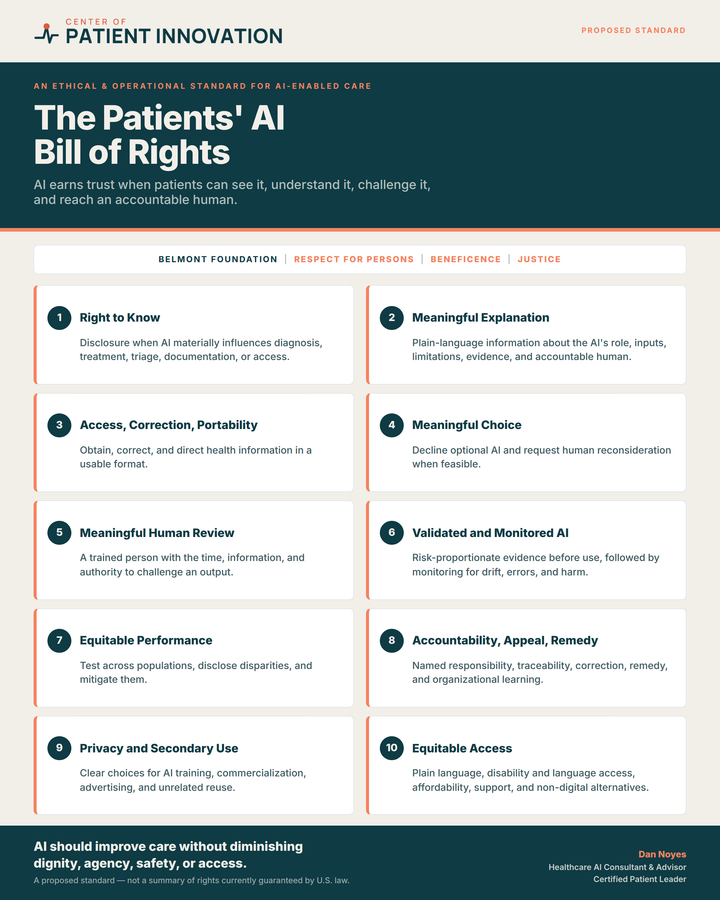
Patients AI Bill of Rights - The Foundation The concepts of creating a patient's bill of rights, including a respect for persons, beneficence, and justice, as outlined in the Belmont Report.
Your Chatbot Therapist Is Listening. But Who Else Is? In the search for accessible mental health support, millions have turned to AI chatbots. These digital tools promise a confidential, stigma-free space to discuss our deepest anxieties.